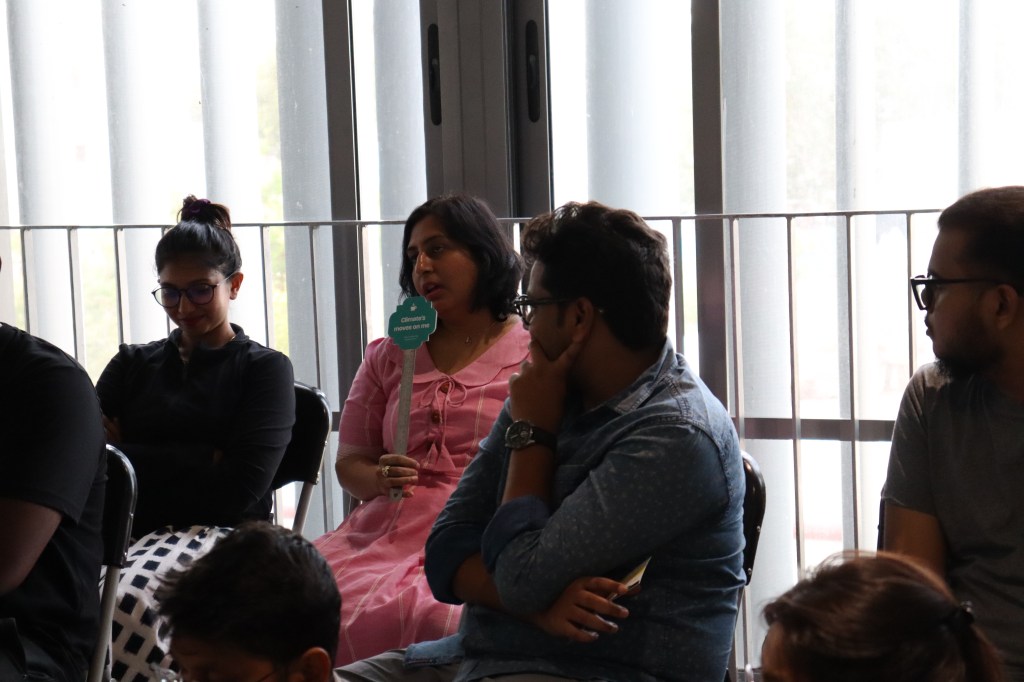
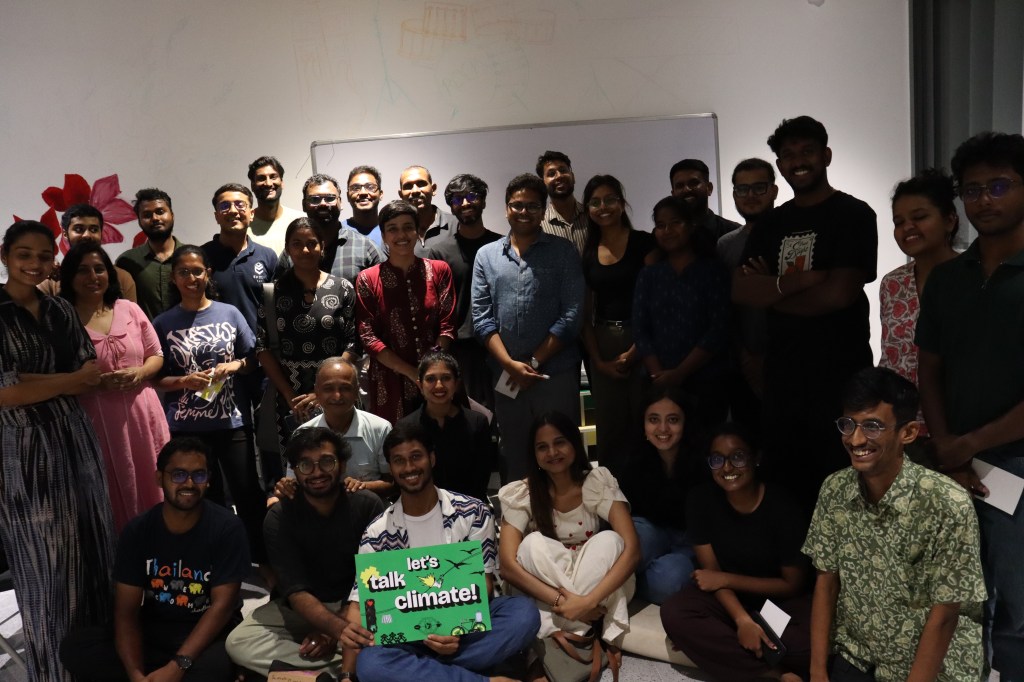
Last week, I attended Let’s Talk Climate, a community gathering hosted at Quest, Besant Nagar.
The event was designed to make climate conversations more accessible, participatory, and human. Rather than relying solely on scientific reports, policy documents, or technical jargon, the organisers encouraged participants to explore climate issues through storytelling, lived experiences, dialogue, and a mock trial.
The evening began with a simple question:
How has climate change affected you personally, and what climate action have you taken in response?
As I listened to others share their experiences, I realised that my own climate journey did not begin with climate reports, sustainability certifications, or professional work in the sector.
It began much earlier.
Growing up in Chennai in the 1990s, I have witnessed dramatic shifts in the city’s environment and weather patterns. I grew up in an independent house surrounded by trees, gardens, and opportunities for kitchen gardening. Over time, like many urban residents, we moved into apartment living where green spaces became smaller and increasingly scarce.
I have experienced recurring water stress, changing rainfall patterns, extreme weather events, the 2004 tsunami, the Chennai floods, and countless summers that seemed hotter than the last. Long before climate change became a mainstream topic of discussion, many of us were already experiencing environmental change in our daily lives.
At the same time, growing up in a middle-class household meant that resource consciousness was not a lifestyle trend.
It was simply how we lived.
We reused containers. We repaired things before replacing them. We wore hand-me-downs. We thought carefully before making purchases. We avoided waste wherever possible. We learned to stretch resources because that was the practical thing to do.
Looking back, many of the sustainability practices that are widely discussed today were already embedded in the lives of countless Indian families.
As I grew older, that awareness evolved into action.
Personally, I experimented with many forms of environmental action, including waste segregation, recycling, mindful consumption, reducing unnecessary purchases, supporting local businesses, reusing materials, and being conscious of resource use.
Professionally, that journey expanded into environmental volunteering, sustainability advocacy, community building, startup ecosystem support, workshops, keynotes, panel discussions, mentoring founders, and eventually building EcoHQ as a platform to advance conversations around climate, sustainability, innovation, and impact.
However, the most emotional part of the evening came later.
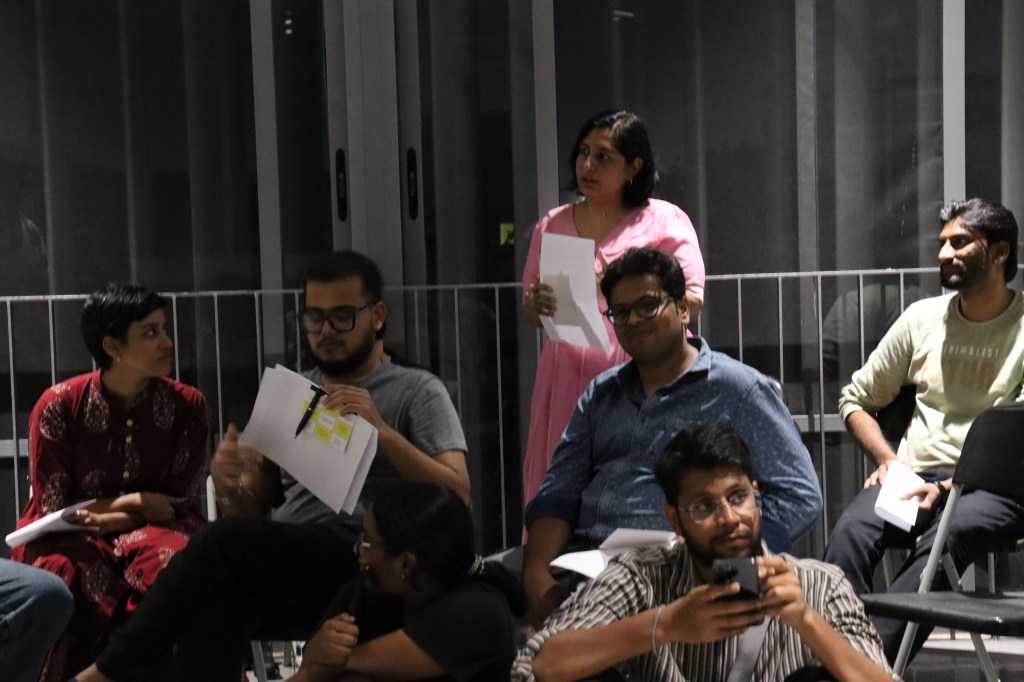
One of the main activities was a mock trial inspired by the Sterlite-Thoothukudi case.
Participants were divided into teams representing different sides of the argument. My group was assigned to the prosecution.
The objective was not to recreate a legal proceeding. Instead, the organisers wanted participants to understand how climate storytelling works. They encouraged people to build arguments using facts, narratives, emotions, personal experiences, and real-world examples rather than relying exclusively on technical language.
For many participants, it was a fun and highly engaging exercise.
For me, it unexpectedly opened the door to memories from a very different chapter of my life.
Between 2007 and 2011, while pursuing social work, I interned as well as worked in hospital settings where I spent time interacting with patients and caregivers facing some of life’s most difficult circumstances.
One group that left a lasting impression on me were families connected to the Kolar Gold Fields region.
Many of the stories I heard involved generations of mining work and the health challenges that followed. I encountered patients battling cancers, neurological disorders, degenerative conditions, and other serious illnesses. Some families had already lost parents or close relatives at a young age. Others were caring for children and young people living with chronic conditions and lifelong medical challenges.
Whether sitting beside patients, speaking with caregivers, or simply listening to families describe their experiences, I began to understand that illness rarely affects just one person.
Its consequences ripple through entire families.
Many children had lost their parents and were being raised by relatives. Some families had exhausted their savings trying to secure treatment. Others faced years of uncertainty while managing ongoing medical conditions.
In several cases, the consequences appeared to span generations. Families spoke about parents, siblings, and children all living with severe health challenges. Whether the causes were occupational, environmental, socioeconomic, or a combination of factors, what struck me was how suffering did not remain confined to one individual. It travelled through households, shaping childhoods, livelihoods, education, and futures.
As part of my internship, I regularly spent time in the wards talking with patients and caregivers.
Every few weeks, I would return and discover that someone I had spoken with had passed away. Those experiences were difficult to process as a young student.
What affected me even more was what happened after death.
For many families, the struggle did not end when a loved one passed away. Some lacked the resources to transport bodies back to their hometowns. Others struggled to arrange funeral services or complete basic administrative processes. I remember occasions when we found ourselves advocating with authorities and support systems simply to ensure that families could give their loved ones a dignified farewell. It was a sobering lesson that poverty, illness, and vulnerability do not end at death. Even dignity can become something people must fight for.
The experience taught me something that has stayed with me ever since.
Behind every discussion about environmental degradation, occupational exposure, industrial pollution, public health, or community vulnerability are real people carrying burdens that are often invisible to the rest of society.
There are caregivers. There are grieving families or the bereaved. There are children forced to grow up too quickly.
There are communities that continue carrying consequences long after public attention has moved elsewhere, sometimes inter-generationally.
As the mock trial unfolded, many of those memories resurfaced.
What was fascinating, however, was watching the rest of the room become completely immersed in the exercise.
People argued passionately. They challenged one another. They defended their positions. They wrestled with conflicting evidences.
For a moment, the room felt less like a workshop and more like a real public hearing.
When the session ended, the discussions continued.
Participants reflected on how difficult it can be to navigate bureaucracy, institutional inertia, regulatory complexity, corruption, competing interests, and the realities of advocating for environmental protection and community wellbeing.
Many walked away with a deeper appreciation of the challenges faced by activists, policymakers, scientists, community leaders, and citizens attempting to drive change.
Later, the organisers explained that this was exactly the point.
Climate communication is often dominated by statistics, scientific terminology, jargons, policy frameworks, and technical reports.
While these are essential, they are rarely enough on their own.
People connect with stories. They connect with lived experiences. They connect with emotions. They connect with people.
The mock trial demonstrated that climate storytelling is not about replacing facts with emotions. It is about helping people understand why those facts matter in the first place.
For me, the event was unexpectedly emotional. For many others, it was interactive, engaging, and eye-opening. For everyone in the room, it was a reminder that climate change is not merely an environmental issue.
It is a human one. It is about water scarcity and extreme weather. It is about livelihoods and health. It is about communities and resilience. It is about justice and dignity.
Perhaps that is why the mock trial affected me differently. For many participants, it was an exercise in climate storytelling. For me, it was a reminder that behind every environmental debate, policy dispute, or industrial controversy are real people whose stories rarely make it into the headlines.
And those stories are often the hardest to forget. And sometimes, it is about stories that stay with us long after the event has ended.
A good climate event informs people. A great climate event helps people feel the complexity of the challenge.
Let’s Talk Climate managed to do both. Thank you, Vinod Sridhar and Bragadeeswar G of For All Kind for making this happen.


Leave a comment